
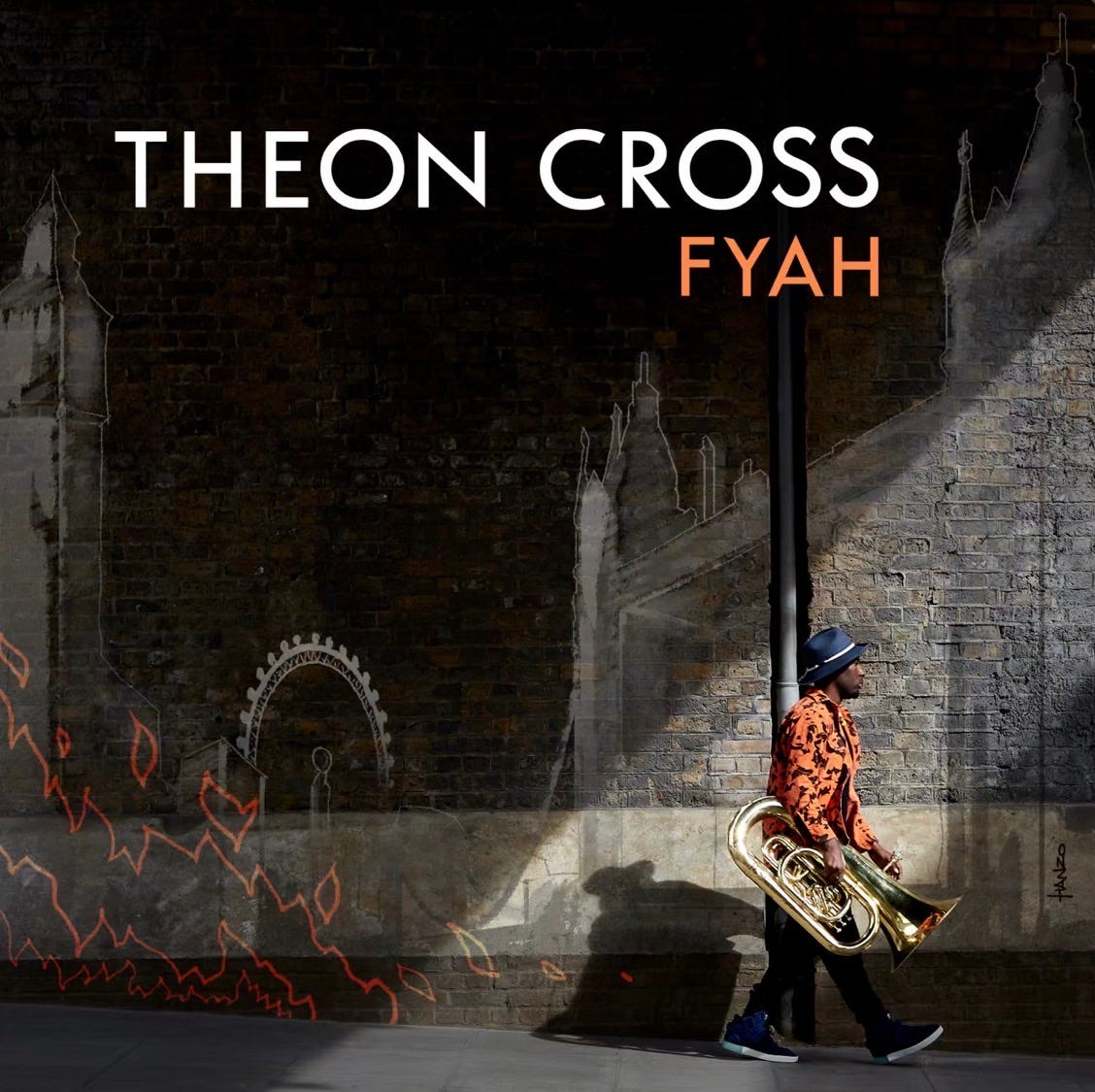
Theon Cross: Fyah
Theon Cross
Fyah (2019)
Theon Cross - tuba
Moses Boyd - drums
Nubya Garcia - tenor sax
Wayne Francis (Ahnansé) - tenor sax
Artie Zaitz - electric guitar
Tim Doyle - percussion
Nathaniel Cross - trombone
My favorite tracks
“Letting Go”
https://youtu.be/FOf0KiISVXg?si=0aFOd87ToDP1ZKbr
“CIYA”
https://youtu.be/3lpfgoO_I6o?si=K4eFfnBB1fjUVQkj
Theon Cross belongs to a generation of musicians that fundamentally changed how the world hears British jazz. Long before international publications started declaring London the most exciting jazz scene on the planet, Cross and a loose cohort of South London peers were already doing the work quietly, building something real from the ground up.
That circle included Nubya Garcia, Moses Boyd, Shabaka Hutchings, and Kokoroko, and what connected them was not a single sound but a shared set of reference points rooted in contemporary Black British life. Jazz was the frame, but the music they made drew equally from grime, dub, Afrobeat, dancehall, UK garage, gospel, hip-hop, and the Caribbean sound system culture that had shaped their neighborhoods long before any of them picked up an instrument.
Among that generation, Cross emerged as one of its most distinctive voices, and a large part of what sets him apart starts with the instrument itself.
The tuba has traditionally occupied a supporting role in jazz, functioning as a bass anchor or the occasional novelty act. Cross never saw it that way. He understood that in the right hands the tuba could be rhythmic, melodic, and harmonically expansive all at once, not a background instrument but a lead voice capable of being the center of attention. More than that, he recognized something others had missed: the tuba's enormous low end presence connected naturally to the bass heavy culture of modern London music.
By the time Fyah arrived in 2019, Cross was already an essential figure within the city’s thriving jazz ecosystem. He had developed through Tomorrow’s Warriors, performed with Sons of Kemet, appeared on the influential We Out Here compilation, and established himself as one of the central architects of London’s emerging sound. Yet Fyah represented something different. It was his opportunity to articulate that vision fully under his own name.
Released on Gearbox Records, the album features Cross alongside a band that reads like a snapshot of the movement at its most vital. Tenor saxophonist Nubya Garcia and drummer Moses Boyd, two musicians who have gone on to become defining figures of the London renaissance in their own right, anchor the core trio, while Wayne Francis on tenor saxophone, Artie Zaitz on electric guitar, Tim Doyle on percussion, and Nathaniel Cross on trombone round out the expanded ensemble on selected tracks.
Together they create a sound that feels simultaneously ancient and futuristic, rooted in jazz improvisation while drawing equally from dub, grime, Afro-Caribbean rhythms, and contemporary club music. No single instrument dominates for long. The music moves fluidly, layered by rhythmic shifts and dynamic interplay.
The album opens with the bruising “Activate”. Cross and Boyd crash into the groove with blunt force. The tuba functions less like a traditional bass instrument and more like a massive sound system speaker brought to life. Boyd’s drumming shifts fluidly between jazz improvisation informed by drum-and-bass, while Garcia’s tenor rides above, acting as the perfect balance to bass heavy percussion happening beneath her.
The groove is repetitive by design. Cross builds the composition around short, call-and-response-like figures that accumulate power through repetition. Garcia responds by stretching long melodic lines over the top, creating tension without disrupting the broader momentum of the piece.
“The Offerings” unfolds with patiently. Boyd’s drumming draws from Nyabinghi traditions and Afro-Caribbean rhythmic concepts while Cross proves himself an astute lyrical composer. The melody breathes naturally, allowing Garcia to respond with long, spacious phrases.
The result is a reflective composition that balances meditative and dirge qualities without sacrificing momentum. The groove remains central, but the emotional temperature shifts from urgency toward reflection.
“Radiation” leans into a muscular funk that’s an instant head nodder. Built around one of Cross’s most infectious bass figures, the track feels equal parts George Clinton, dub reggae, and contemporary London club music. Boyd creates a layered percussive framework that shifts and accents without ever losing cohesion.
Garcia stands out with measured phrasing that leans into repetition without sacrificing lyricism. Cross continues expanding the traditional responsibilities of the tuba. Rather than merely supporting the harmony, he drives the composition from within, acting simultaneously as bassist, rhythm section, and melodic voice.
At over seven minutes, “Letting Go” becomes one of the album’s most expansive statements. The composition unfolds gradually through dynamic shifts and extended improvisation. Cross delivers one of the record’s strongest solos, moving confidently through the upper register of the instrument while demonstrating remarkable agility and breath control.
The track also highlights the groups chemistry. Boyd and Garcia react instinctively to every shift in direction, allowing the music to develop organically rather than through rigid structure. It serves as perhaps the most complete statement on the album of the multiple cultural influences that inform its direction.
“Candace of Meroe” pushes the pace. Joined by Wayne Francis, Nathaniel Cross, Artie Zaitz, and Tim Doyle, the group leans heavily into Afrobeat influences. The title references the ancient Kingdom of Kush, connecting the music to broader Pan-African historical themes that frequently emerge throughout London’s contemporary jazz movement. Zaitz’s guitar introduces a distinctly West African rhythmic feel while the expanded horn section creates a richer sonic landscape. Yet Cross remains the connective tissue, anchoring the ensemble through powerful bass lines that hold everything together.
“CIYA” is built around a warm, soulful groove that recalls late ’70s fusion and early soul jazz traditions that would later influence neo-soul. The composition highlights Cross’s melodic sensitivity. His solo is remarkably tender, allowing the tuba to function as a genuinely romantic lead instrument. The track also demonstrates the breadth of his influences. While much of the album emphasizes rhythmic power, “CIYA” reminds listeners that groove and beauty are not opposing concepts. They often reinforce one another.
Fyah arrived at a moment when London jazz was finally receiving widespread international attention, but Cross never sounds interested in validating the scene to outsiders. Instead, he creates music that reflects the community from which it emerged. Jazz exists alongside grime. Afrobeat coexists with dub. Caribbean traditions live comfortably beside improvisational language inherited from generations of jazz musicians.
That understanding has helped establish Theon Cross as one of the movement’s most important leaders. Like many of his peers, he rejects the idea that jazz must remain fixed in a particular era to maintain its integrity. Instead, he treats it as a living language capable of absorbing new influences while remaining connected to its roots.
Fyah stands as a defining statement of that philosophy. For Cross, it marked the moment he stepped out from the shadow of other important projects and established himself as a visionary bandleader in his own right. For the broader London scene, it remains one of the clearest demonstrations of what made the city’s renaissance so compelling in the first place. The album does not merely document a movement. It helps define it.
-All Things Jazz-
Thank you for introduction to Theon Cross. ✨ Love it when bass gets to shine but all of the compositions were so interesting/fresh. What an amazing scene for cross pollinatuon. 🇬🇧 🎡
Was on a Celeste 🌹 arc this morning so had to go look up if Theon had worked with her. Read she has been inspired by him and although not directly worked together have both performed at one event.
Thanks again for a introduction and well written read to a cool jazz scene.