Jimmy Smith: The Sermon
Jimmy Smith
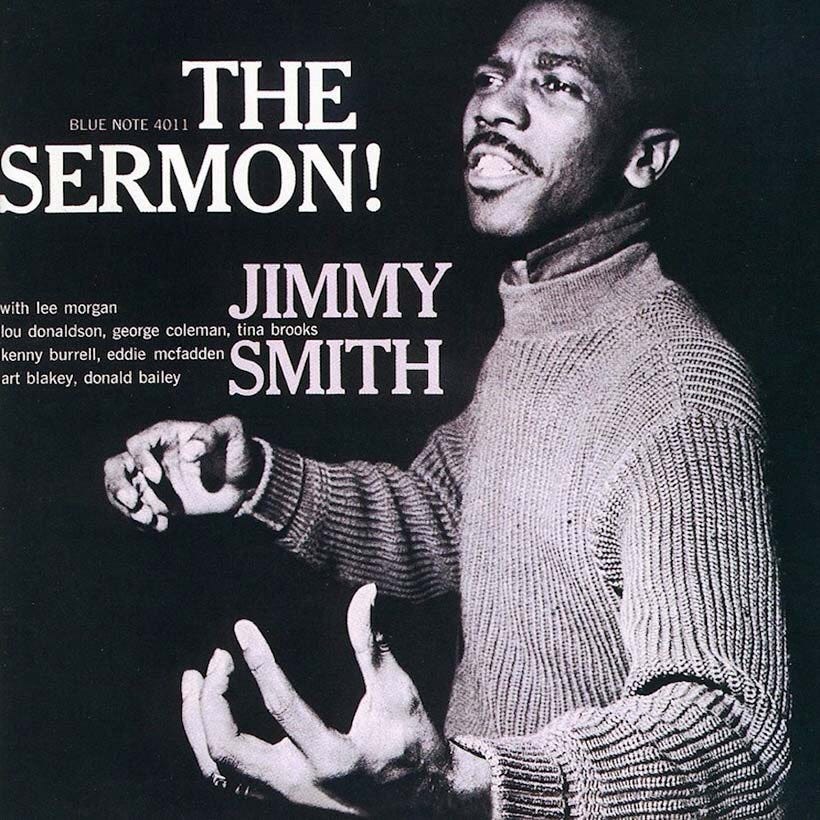
The Sermon (1959)
Jimmy Smith - organ
Lee Morgan - trumpet
Kenny Burrell - guitar
Art Blakey - drums
Lou Donaldson - alto sax
Tina Brooks - tenor sax
George Coleman - alto sax
Eddie McFadden - guitar
Donald Bailey - drums
My favorite track
"The Sermon"
https://youtu.be/e3X5J_wGHrw?si=hq9fHPAFbTdDWh3a
“J.O.S.”
https://youtu.be/r-d28y4PoPs?si=WyPKo_Cavi06489j
Jimmy Smith did not invent the Hammond organ in jazz, but by the end of the 1950s he had completely changed its place inside the music. Before Smith, the organ was often treated like a novelty instrument. Too boisterous for virtuosity, and not subtle enough to fit upscale standards. After Smith, it became its own ecosystem. He stretched the organ’s language by pouring bebop lines, blues testimony, and gospel cadences into long, rolling choruses that made the B3 sound multi dimensional.
Smith’s range was noteworthy because he could take commanding solos then easily turn around and comp with the same authority, slipping behind horns and guitars with riffs accenting without ever crowding their space. The Sermon! is one of the clearest documents of that command and versatility, the moment where his expanded organ language unlocks a level of groove that reorders everything around him, and forms the kind of deep, collective pulse that marks a classic rather than just another blowing date or jam session.
Recorded across two sessions in 1957 and 1958 and released by Blue Note in 1959, The Sermon! captures Smith refining the practical blueprint for soul jazz before the term had fully hardened into a category. The ingredients sound simple on paper: blues themes, hard bop phrasing, deep groove, long improvisations, and church inflected rhythm. What gives the album its gravity is how confidently those elements are organized. Smith understood that groove itself could structure an entire performance without sacrificing sophistication.
By the time The Sermon! arrived, Smith was already recording at a staggering pace for Blue Note. Alfred Lion and Rudy Van Gelder recognized quickly that Smith’s Hammond B-3 could bridge multiple audiences at once. Bebop musicians respected his harmonic command. Club audiences responded to the blues and gospel feel. The organ itself could function as bass instrument, harmonic center, and lead voice simultaneously. That versatility allowed Smith to reshape the entire small group format around himself.
The sessions themselves reflected that ambition. Recorded at Van Gelder’s Hackensack studio, the lineup rotates between an all-star collection of hard bop musicians including Lee Morgan, Lou Donaldson, Tina Brooks, George Coleman, Kenny Burrell, Eddie McFadden, Art Blakey, and Donald Bailey. Rather than tightly arranged compositions, the album leans heavily on extended jam structures. The performances are essentially live to tape, long uninterrupted takes where the groove becomes the organizing principle, and the rawness becomes part of the gravity.
The title track, “The Sermon,” occupies the entire first side of the original LP and immediately establishes the album’s philosophy. Built on a relaxed 12-bar blues, the performance stretches past twenty minutes without losing momentum. Smith opens with a steady walking bass line underneath sparse blues phrases, establishing the groove before gradually thickening the harmonic movement.
The track avoids sounding like an extended jam session because Smith and Blakey maintain steady time without overcrowding the opening minutes, allowing the repetition itself to create tension. Kenny Burrell follows with a measured but lyrically blues centered solo. The horns each approach the blues differently, but the performance never fragments because Smith keeps the foundation steady underneath them.
The genius of the track is structural. Smith demonstrates that soul jazz could sustain long form improvisation without relying on complex harmonic movement or over extended vamps that become monotonous. The groove itself becomes the narrative engine. That idea would define organ driven jazz for the next decade.
“J.O.S.” shifts the energy upward immediately. Named after Smith’s initials, the track is faster, sharper, and more aggressive than the title piece. Donald Bailey’s drumming pushes the rhythm section harder, while Smith attacks the Hammond with more forceful phrasing and percussive chord stabs. The blues foundation remains intact, but the feel is more nimble. Lee Morgan’s solo is superb, balancing his signature grit with gliding lyrical phrasing that accents and asserts itself without ever abandoning the pocket established by the rhythm section.
Smith’s playing here highlights how much bebop language still sat underneath his soul jazz innovations. The runs are quicker, the harmonic substitutions arrive more suddenly, and the dynamic movement inside the soloing becomes more volatile. Smith never treats groove and sophistication as opposing ideas. “J.O.S.” swings hard, but the rhythmic pocket remains central. Even at higher intensity levels, the music stays physically grounded.
“Flamingo” closes the album by slowing everything down. After two extended blues workouts, the ballad functions almost like a benediction. Lee Morgan and Kenny Burrell prove their versatility through their lyrically probing approach to the arrangement. Art Blakey, so often associated with explosive rhythmic force, becomes remarkably subtle here.
Smith himself pulls further into the background for much of the performance, comping gently rather than dominating the arrangement. He shapes the emotional environment of the music even when the spotlight shifts elsewhere. “Flamingo” also reinforces something essential about early soul jazz that often gets overlooked. The style was never purely about funk or dance rhythms. Ballads and other emotionally direct compositions fit just as naturally inside the language.
From a broader historical perspective, The Sermon! matters because it established a working model that countless musicians would build from afterward. The album effectively standardized several core soul jazz principles at once: Hammond organ as central voice, blues based themes stretched into extended improvisation, and groove functioning as the primary organizing force.
At a moment when jazz was splintering into multiple competing futures, Jimmy Smith chose something more direct. He trusted the groove as a fundamental organizing tool for modern jazz. That decision proved enormously influential.
The Sermon! does not announce itself as revolutionary in the abstract intellectual way some late 1950s jazz landmarks do. Its importance is more practical. Jimmy Smith understood that innovation in Black music rarely means abandoning the foundation. It means building from it and finding what’s new within the fundamentals of what has always translated soul into movement
-All Things Jazz-
This is so ON!
Smith didn't invent the Hammond. He just made everyone else realize there was a hipper way to play it.
Wild Bill Davis got there first with the organ trio format, but Smith walked in and said "okay, let me show you how it’s done” — then proceeded to play bebop lines with his right hand, bass lines with his feet, and comp chords in between. All while making it groove harder than anyone thought possible on an instrument that looked like church furniture.
McGriff and McDuff were monsters. They stayed in Smith's lane because the lane was perfect.
Larry Young tried to escape in the mid-'60s with modal experiments. Even his rebellion was basically "what if we did Smith's thing but throw in some Trane!”)
Then rock heard the blueprint and stole it.
Booker T. took Smith's architecture — bass pedals, sparse melodic phrases, groove as the entire structure — and carved it down to three minutes. "Green Onions" is Smith without the twenty-minute sermon. Same church. Faster service.
Gregg Allman heard it and went the other direction. Stretched Smith's vocabulary (those gospel chords, that walking bass, the blues testimony in the right hand) across Southern rock with two lead guitars screaming on top. The Allman Brothers were essentially a rock version of Smith's soul jazz trio.
Which meant every kid who bought a Hammond after 1970 was learning Smith's language whether they knew his name or not.
Jimmy Smith owned the B3. Everyone else just rented it!