
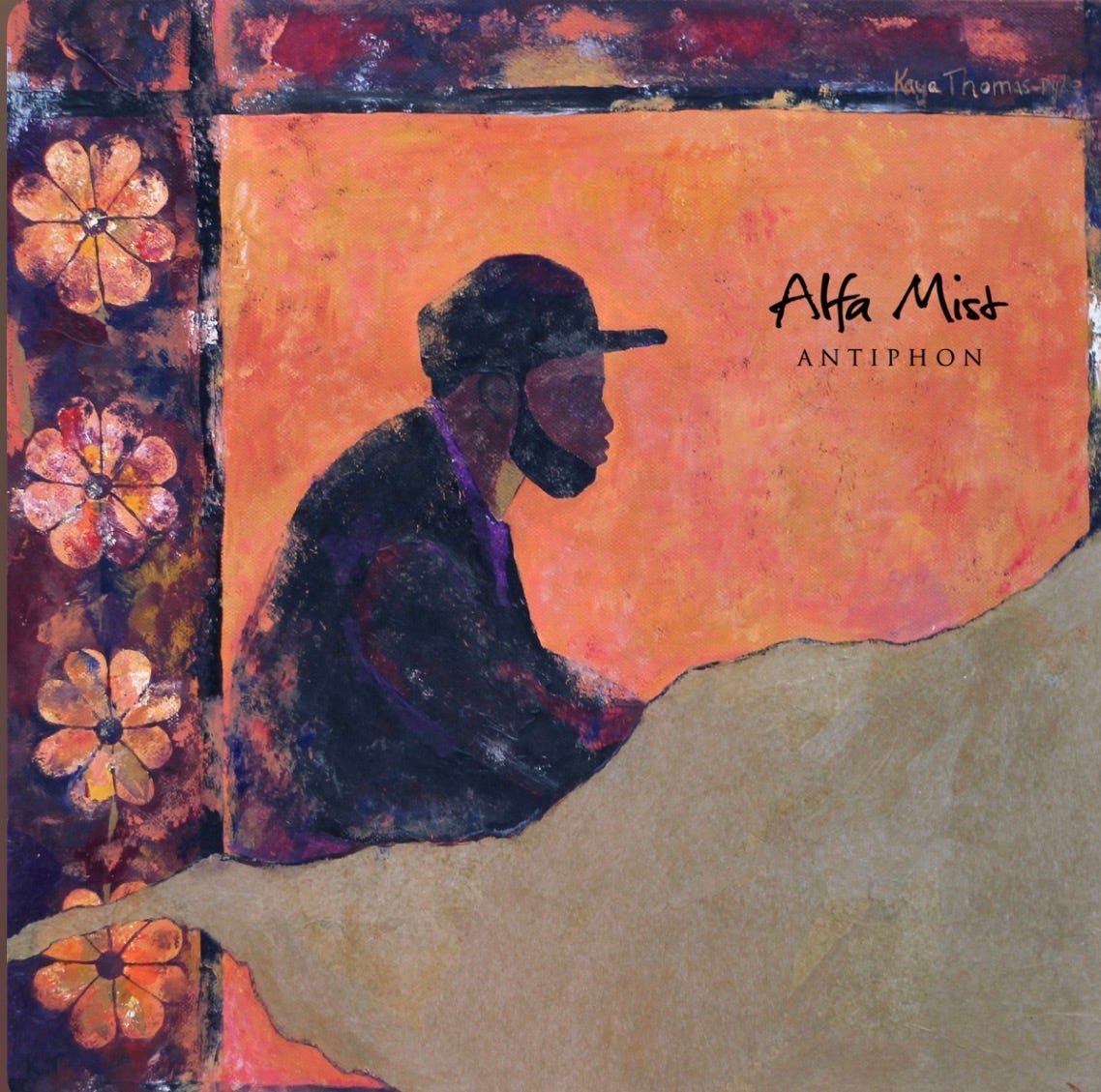
Alfa Mist: Antiphon
Alfa Mist
Antiphon (2017)
Full album credits ⬇️
https://www.discogs.com/master/1204317-Alfa-Mist-Antiphon
My favorite tracks
“Keep on”
https://youtu.be/XrY2m5rdlQQ?is=cJSKLF3mXUhn3Fee
“Breathe”
https://youtu.be/5-hQsfSoxmI?is=-Ri6ayj8wPX9Zqw1
Alfa Mist arrived at Antiphon in 2017 from a direction unique to most jazz artists. He grew up in East London, initially spending his early years on the pitch playing for Torquay United’s U-16 team before his mother insisted he step away and focus on school.
While running in hip-hop circles, he eventually taught himself piano after digging for samples and discovering jazz. The harmonic language was life changing. By the mid-2010s he was releasing collaborative projects with Lester Duval and building creative relationships with fellow London artists like Yussef Dayes, Tom Misch, and Jordan Rakei. Those collaborations steadily expanded his artistic worldview beyond his beginnings as a producer.
After releasing his debut EP Nocturne in 2015, Antiphon was where Alfa Mist really spreads his wings. The album is constructed around a recorded conversation with his brothers about family, mental health, and what it means to remain present in one another’s lives.
The dialogue becomes both the backbone and emotional core of a body of work that moves effortlessly between jazz, soul, and hip-hop. The title Antiphon references antiphonal structure, the concept of call and response. In this case, the familial conversations become the call, while the music provides the response.
Alfa Mist has described his career as a process of slow and steady progress rather than a series of breakthroughs, and that framing fits. Antiphon doesn’t sound like the debut of an artist announcing his arrival. Instead, it sounds like the work of an intellectually curious musician who is constantly learning, absorbing new ideas, and incorporating them into his art without fear. That curiosity becomes the album’s defining strength.
The opener, “Keep On” is built around warm piano voicings, intricate drumming, and a slowly evolving horn arrangement. The pacing of the track is it’s lynchpin. Alfa’s piano avoids flash, instead he focuses on harmonic movement and subtle repetition. The groove remains rooted in a Soulquarians style hip-hop sensibility, but the improvisation is unmistakably jazz driven.
“Potential” features the dynamic Mansur Brown on guitar, and introduces a swirling blues inflected energy. Brown’s playing fluidly balances lyricism and muscularity. His sense of urgency contrasts beautifully with Alfa’s more measured approach. The composition itself revolves around the tension implied by its title. The distance between possibility and realization becomes one of the album’s recurring themes.
Vocalist Kaya Thomas-Dyke guides the stirring “Breathe.” Her voice arrives almost like another instrument within the arrangement, floating above cascading keyboards and a steady rhythm section. The song provides the emotional release that had been building throughout the earlier tracks. While much of Antiphon explores internal dialogue, “Breathe” feels like a moment of clarity emerging from that conversation. The performance also demonstrates Alfa Mist’s gift as an arranger. Every element serves the composition without overwhelming it.
“7th October” draws a direct line to Alfa Mist’s hip-hop background. Unlike the surrounding compositions, this track places him firmly at the center. The production remains consistent with the album’s overall aesthetic, but the emphasis shifts toward lyricism and personal reflection. Rather than feeling like a detour, the song reinforces the idea that jazz and hip-hop exist within the same creative lineage.
Antiphon finds its significance in the way it challenges assumptions about what contemporary jazz can sound like. The album emerged from a scene that regularly drew inspiration from hip-hop, grime, soul, and electronic music, but Alfa Mist’s gift lies in how naturally those influences coexist.
More importantly, Antiphon demonstrated that introspection in modern jazz does not have to be mundane or unnecessarily brooding. Alfa navigates the emotions that emerge from the album’s familial themes without losing sight of broader musical ideas along the way.
Antiphon feels honest. The conversations with his brothers provide the framework, but the music carries the emotional weight. Anxiety, uncertainty, growth, connection, and self-discovery are embedded in the harmonic language, rhythmic choices, and pacing of the album itself.
Years after its release, Antiphon remains one of the defining statements of contemporary jazz because it demonstrates how expansive the music can become when an artist is willing to let vulnerability guide the creative process. Few albums capture internal reflection with this much warmth or clarity. Antiphon doesn’t simply invite listeners into Alfa Mist’s world. It encourages them to spend time examining their own.
-All Things Jazz-
I really like Alfa Mist. Did a You Tube short with him in it. Check it out if you like…
https://youtube.com/shorts/psJykw-b0XI?si=dFvTdfeIomDHJ5E1
❤️